

How big is 3mm? Three millimeters is a very small measurement, about the thickness of a few thin sheets of paper stacked together. It equals 0.3 centimeters or approximately 0.118 inches. Although this measurement looks tiny, you can find similar dimensions in small craft supplies, mechanical parts, and jewelry materials.
Understanding what 3mm looks like becomes easier when you compare it with familiar objects. A small craft bead, a miniature ball bearing, or a tiny rhinestone can provide a useful size reference. However, the exact dimensions of these items vary by design and manufacturer.
In this guide, you will discover 14 examples of objects that can measure around 3mm. You will also learn how to convert 3mm to inches, compare it with a ruler, and understand its actual size.
How Big Is 3mm in Inches and Centimeters?
Three millimeters is equal to 0.3 centimeters and approximately 0.118 inches. In everyday measurements, this is slightly smaller than one-eighth of an inch.
Here is a quick conversion chart to help you visualize this measurement.
| Measurement | Equivalent |
|---|---|
| 3 millimeters | 3 mm |
| 3mm in centimeters | 0.3 cm |
| 3mm in inches | 0.118 inches |
| 3mm in fractions of an inch | About 1/8 inch |
| 3mm in meters | 0.003 meters |
Remember that 1/8 inch equals 3.175mm, so it is slightly larger than 3mm.
What Does 3mm Look Like?
Imagine a tiny round bead measuring 3mm across. It would look small on your fingertip and could easily fit among other miniature craft materials.
A 3mm measurement can describe length, width, thickness, or diameter. These terms are not interchangeable. For example, a bead might measure 3mm across but have a different height. Always identify which dimension you are measuring.
14 Common Things That Are About 3mm Big
The following examples help you understand a 3mm size comparison. Some products are available in exactly 3mm dimensions, while other examples vary naturally. Check the stated measurements when exact accuracy matters.
1. Small Craft Bead
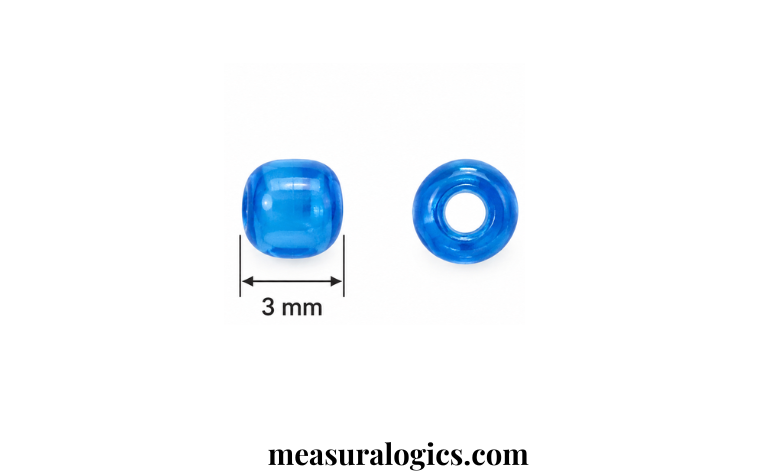
A small craft bead measuring 3mm in diameter offers one of the easiest ways to visualize this size. These miniature beads are available in glass, plastic, wood, and other materials.
You can find small beads in jewelry-making kits, bracelet supplies, and decorative craft collections. A 3mm bead looks tiny beside standard-sized beads and may be difficult to handle with your fingers.
When choosing this example, check the package dimensions. Some beads measure 3mm across, while others are larger or smaller.
2. Mustard Seed
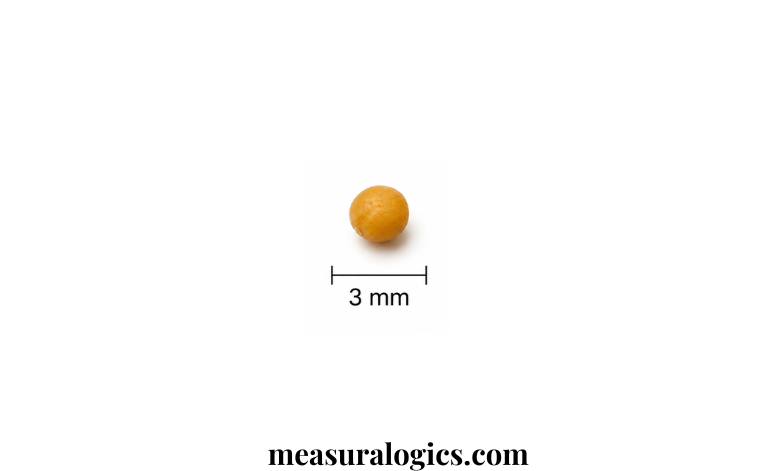
Mustard seeds provide another familiar reference for understanding tiny measurements. Many mustard seeds are only around 1–2mm across, although their sizes vary by variety.
Some larger seeds may approach 3mm in a particular dimension. However, a mustard seed should not be treated as an exact 3mm reference without measuring it.
If you want to compare a seed with this measurement, place it beside a millimeter ruler. This simple comparison shows how small natural objects can be.
3. Thin Wire

A wire with an outside diameter of 3mm is a useful example of this measurement. It may appear narrow when viewed from the side, but its circular end makes the thickness easier to understand.
Wires of this diameter can be found in certain craft, electrical, and mechanical applications. Their materials and intended uses vary considerably.
Remember that wire diameter refers to its thickness across the circular section. It does not refer to the wire’s total length.
4. Small Plastic Spacer

A miniature plastic spacer can measure approximately 3mm across or in thickness. These small components help maintain gaps between parts in crafts, models, and mechanical assemblies.
Some spacers have a central hole, while others are solid. Their outside diameter, inside diameter, and height may all differ.
For a reliable comparison, select a spacer with a listed 3mm measurement. Then use that dimension to understand how small three millimeters really is.
5. Small Rhinestone

A 3mm rhinestone is a practical example of a tiny decorative object. These stones are commonly used on clothing, accessories, jewelry, and handmade decorations.
At this size, a rhinestone can look like a small sparkling dot. Its reflective surface may make it appear more noticeable than a plain object with the same dimensions.
Rhinestones come in different shapes and sizes. Check whether the listed measurement describes the stone’s width, diameter, or longest side.
6. Small Plant Seed
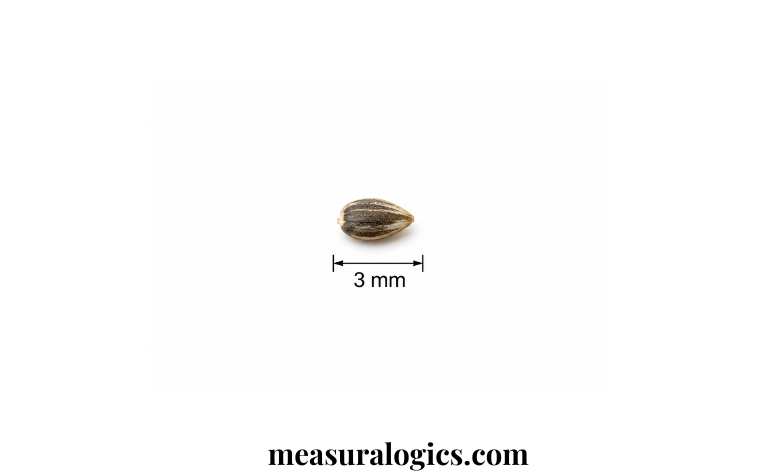
Some plant seeds measure around 3mm in length or width. Their size depends on the plant species, seed variety, and shape.
A small seed can help demonstrate how a measurement of three millimeters compares with objects found in nature. However, not every small seed is this size.
For an accurate example, choose a seed with known dimensions or measure one under good lighting. A magnifying glass can make the comparison easier to see.
7. Miniature Ball Bearing
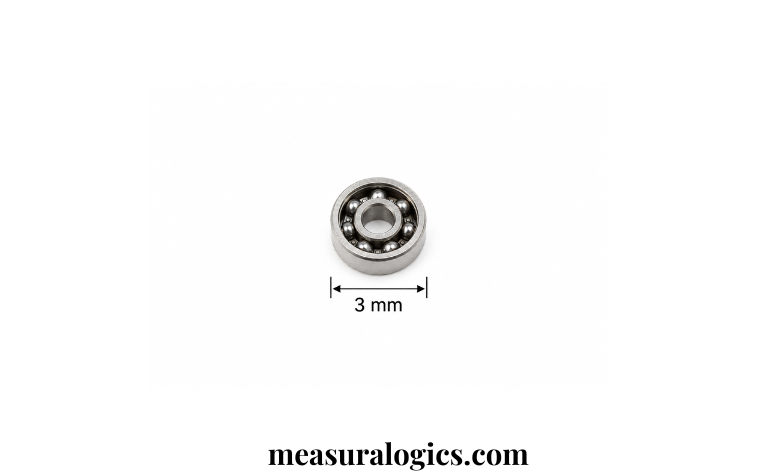
A miniature ball bearing with a 3mm ball diameter provides a precise mechanical reference. These small metal spheres are used in certain miniature mechanisms, model equipment, and specialized components.
A single 3mm ball bearing is small enough to sit on a fingertip. Its smooth, rounded shape also makes its diameter easy to describe.
Be careful when buying ball bearings because product listings may specify the ball diameter or the bearing’s overall dimensions. These measurements describe different things.
8. Tiny Craft Sequin

Some craft sequins are available in sizes around 3mm. These small decorative pieces can add color and shine to greeting cards, clothing, artwork, and handmade projects.
A round 3mm sequin is a useful example because its width can be compared directly with a ruler. Its flat shape also demonstrates how an object can have a tiny diameter but very little thickness.
Sequin sizes vary, so choose a product with a stated 3mm width when using this example for an exact comparison.
9. Small Spacer Bead

A small spacer bead measuring 3mm across can help you visualize this dimension. Jewelry makers use spacer beads between larger beads to create patterns and separate decorative elements.
These beads may be round, cylindrical, or slightly flattened. As a result, their width and height might not be identical.
For a clear 3mm size reference, look for a bead whose listed diameter is exactly 3mm. You can then compare it with other beads or a millimeter ruler.
10. Miniature Metal Washer

A miniature metal washer can measure approximately 3mm in its outer diameter, thickness, or another dimension. Washers are small flat components used with screws and bolts in many assemblies.
Their ring-shaped design makes measurement especially important. A washer’s outside diameter differs from its center-hole diameter.
If you use a washer as an example, confirm which dimension measures 3mm. A washer with a 3mm hole might have a much larger outside diameter.
11. Miniature Googly Eye

Tiny googly eyes are available for miniature crafts and decorative projects. Some versions measure close to 3mm across, making them a useful visual reference.
These small craft supplies often have a clear plastic cover and a movable black center. Their appearance makes them easy to identify among other miniature items.
Not every googly eye measures 3mm. Check the product size before using one to demonstrate an exact measurement.
12. Tiny Rubber O-Ring

A small rubber O-ring can provide another example of a component measuring around 3mm. O-rings are circular seals used in various mechanical systems to help prevent fluid or air leakage.
However, an O-ring has several dimensions. Its inner diameter, outer diameter, and cross-sectional thickness are different measurements.
For instance, an O-ring with a 3mm cross-section may have a much larger overall diameter. Always identify the specific dimension before comparing it with other objects.
13. Small Plastic Connector
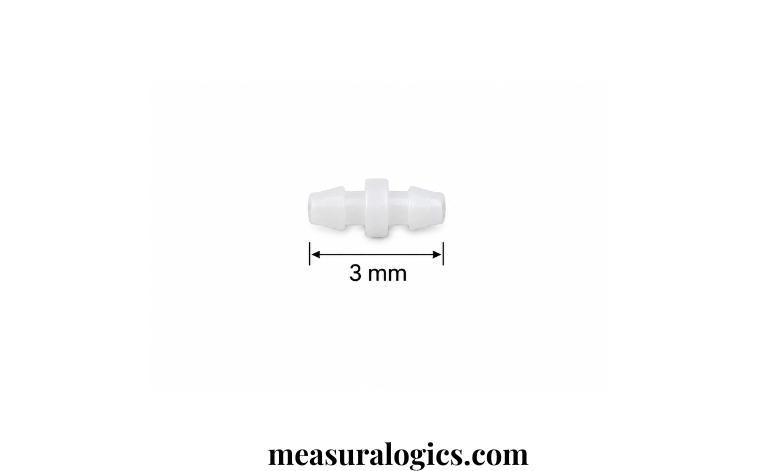
Some miniature plastic connectors have a width, opening, or pin spacing of approximately 3mm. Small connectors are used in electronics, hobby projects, and compact assemblies.
Their shapes vary, so the entire connector may be much larger than 3mm. The measurement might describe only one small feature.
When selecting a connector as a size reference, check its technical drawing or product specifications. This helps you avoid confusing the connector’s overall size with one of its individual dimensions.
14. Miniature Screw Head

A miniature screw head can measure around 3mm across. These small fasteners appear in electronics, hobby models, small appliances, and precision assemblies.
The head diameter is the distance across the top of the screw head. It differs from the screw’s shaft diameter and total length.
A screw with a 3mm head diameter is a useful way to visualize a small circular measurement. Check the manufacturer’s dimensions to confirm the actual head size.
Also Read: How Long Is 1 Inch? 17 Everyday Objects That Are About 1 Inch Long
How to Measure 3mm Without a Ruler
Measuring three millimeters without a ruler can be challenging because the distance is so small. However, a few simple methods can help you estimate it.
- Use a known-size object: A bead or component labeled 3mm can serve as a reference.
- Check a millimeter ruler: The distance between three consecutive millimeter intervals is 3mm.
- Use a digital caliper: A caliper can measure small widths, diameters, and thicknesses more precisely than visual estimation.
- Inspect product specifications: Manufacturer drawings often list the dimensions of tiny mechanical parts.
- Avoid guessing from photographs: Camera distance, zoom, and perspective can make an object look larger or smaller than it really is.
For accurate work, use a physical measuring tool instead of relying on appearance alone.
Common Misconceptions About 3mm
A common mistake is assuming that every tiny object measures around 3mm. Small beads, seeds, wires, and fasteners come in many different sizes.
Another mistake is confusing length with thickness. A 3mm-long object may be extremely thin, while a 3mm-thick object could be much longer.
It is also important to remember that 3mm is not exactly the same as 1/8 inch. The difference is small, but it matters in precision measurements.
Frequently Asked Questions
What does 3mm look like?
Three millimeters is a tiny distance, approximately 0.118 inches. A craft bead or miniature ball bearing with a 3mm diameter can provide a helpful visual reference.
What can I compare 3mm to?
You can compare 3mm with a bead, a miniature ball bearing, a small rhinestone, or a wire with a 3mm diameter. Always verify the object’s actual dimensions.
What is 3mm in inches?
Three millimeters equals approximately 0.118 inches, which is slightly less than 1/8 inch.
What does 3mm mean?
The abbreviation mm stands for millimeters. Three millimeters means three units on the metric scale, with 10 millimeters equaling one centimeter.
Is 3mm the size of a pea?
No, a typical pea is much larger than 3mm across. Peas vary in size, but a whole pea is not a reliable reference for an object measuring only three millimeters.
How thick is 3mm?
A thickness of 3mm equals 0.3 centimeters or about 0.118 inches. It is slightly less than 1/8 inch.
Final Thoughts
Understanding how big 3mm is becomes easier when you compare it with small objects around you. Craft beads, rhinestones, miniature ball bearings, and small screw heads can all provide useful examples when their dimensions are verified.
Remember that three millimeters equals 0.3 centimeters and approximately 0.118 inches. This is a tiny measurement, but it can matter when choosing parts, completing crafts, or checking product specifications.
For another helpful size comparison, explore our related guide on how big is 5mm to see how a slightly larger measurement compares with everyday objects.

I am Dr. Muhammad Zubair, a mathematician, researcher, and educator with a Ph.D. in Mathematics and postdoctoral research. My research work has been published in reputable, peer-reviewed international journals a reflection of my continued commitment to academic excellence and the advancement of mathematical knowledge. And I am a also experienced blogger at Measura Logic, focusing on all aspects of measurements.