
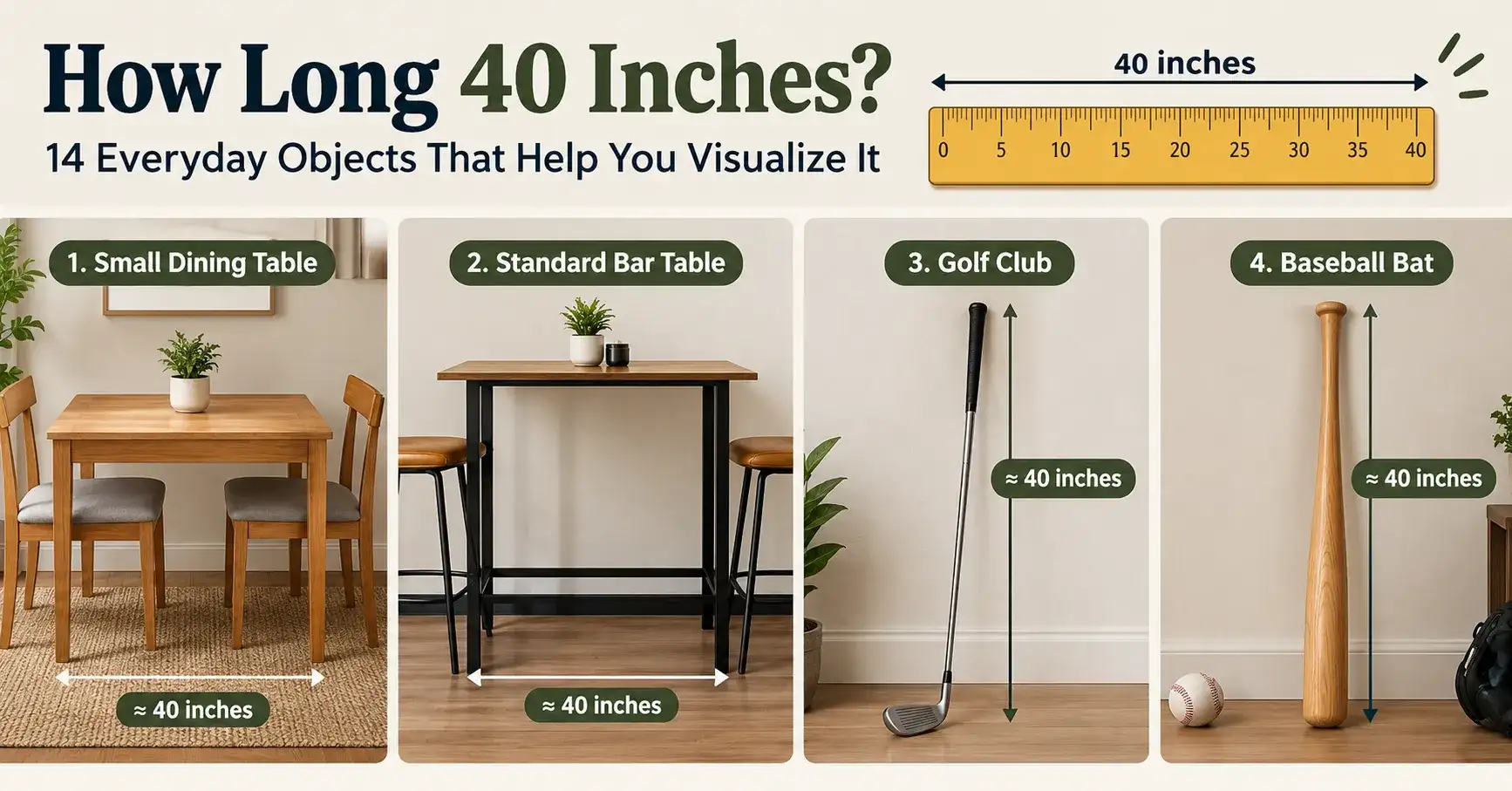
40 inches equals 3 feet and 4 inches, or 101.6 centimeters. This measurement is easy to understand when you compare it with familiar household items, furniture, and everyday tools. These comparisons help you estimate lengths and heights without a measuring tape.
If you wonder how long 40 inches is in real life, picture an object measuring slightly more than three feet. Some bar tables, small bookshelves, garden tools, and other household items may come close to this size. However, their dimensions vary by design and manufacturer.
In this guide, you will learn how to convert 40 inches into other units. You will also discover 14 everyday objects that can help you visualize this measurement.
How Long 40 Inches?
40 inches equals 3 feet and 4 inches. It is also 101.6 centimeters, 1.016 meters, or 1,016 millimeters.
| Measurement Unit | Equivalent |
|---|---|
| Inches | 40 inches |
| Feet | 3.33 feet |
| Feet and inches | 3 feet 4 inches |
| Centimeters | 101.6 cm |
| Meters | 1.016 m |
| Millimeters | 1,016 mm |
To convert inches into feet, divide the measurement by 12. Therefore, 40 divided by 12 equals approximately 3.33 feet.
To convert inches into centimeters, multiply by 2.54. This gives 40 × 2.54 = 101.6 centimeters.
These conversions are useful when measuring furniture, checking product dimensions, planning a room layout, or comparing objects sold with metric measurements.
What Does 40 Inches Look Like in Real Life?
40 inches is slightly longer than three feet. Imagine a vertical distance measuring from the floor to a point 40 inches above it. This gives you a practical sense of the height.
Another way to visualize this measurement is to use a standard 12-inch ruler. Three ruler lengths equal 36 inches. Add another four inches to reach 40 inches.
You can also compare this measurement with furniture and household objects. A compact bookshelf may stand around this height, while a long garden spade may measure close to 40 inches from end to end.
Remember that an object measuring 40 inches tall is different from one measuring 40 inches long. Height measures how high something stands. Length measures the distance from one end to the other. Width measures the distance from side to side.
The following examples provide useful reference points. However, not every item will measure exactly 40 inches. Check the actual dimensions when accuracy matters.
14 Common Things That Are About 40 Inches Long or Tall
These everyday objects can help you picture a measurement of 40 inches. Some illustrate length, while others represent height or width. Their actual dimensions depend on the product and its design.
1. Small Dining Table

A small dining table can help you visualize a measurement close to 40 inches. Some compact tables measure around 40 inches across, making them suitable for smaller dining areas.
Check whether the listed dimension refers to the table’s length, width, or height. A tabletop measuring 40 inches across is very different from a table standing 40 inches tall.
2. Standard Bar Table

Some bar tables stand approximately 40 inches tall. Their raised design makes them useful for comparing vertical measurements around this size.
Measure from the floor to the tabletop to determine the table’s actual height. Bar table dimensions vary, so 40 inches is a reference rather than a universal standard.
3. Golf Club

Some golf clubs measure close to 40 inches from the clubhead to the top of the grip. The exact length depends on the club type, model, and intended player.
Golf clubs are useful for visualizing a long, narrow object. However, not every club reaches 40 inches. Check the manufacturer’s specifications before using one as an exact reference.
4. Baseball Bat
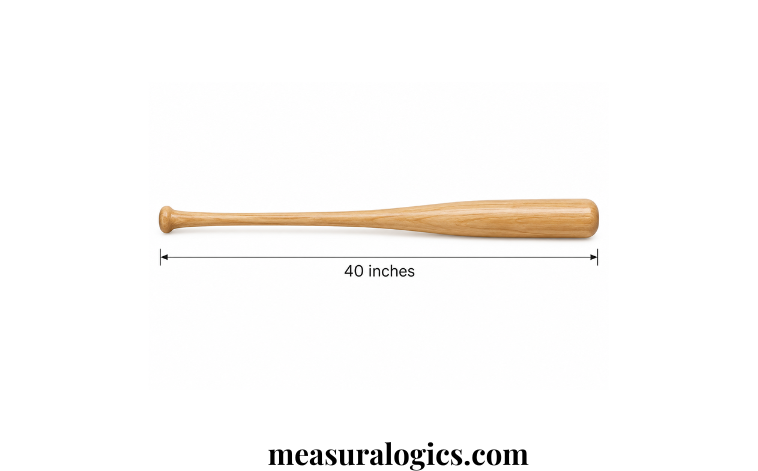
A baseball bat is easy to picture because of its long, narrow shape. However, it is not a reliable example of a 40-inch object. Many standard adult baseball bats are shorter than 40 inches.
Use a bat to understand the general appearance of a long object, but choose a different item when you need a closer comparison. Always verify the bat’s listed length.
5. Toddler Safety Gate

Some toddler safety gates have an opening or overall width close to 40 inches. This can help you visualize a horizontal measurement across a doorway or play area.
Distinguish between the gate’s width and height. Product dimensions may also change when extension panels are added. Check the complete specifications before using a gate as a reference.
6. Kitchen Counter
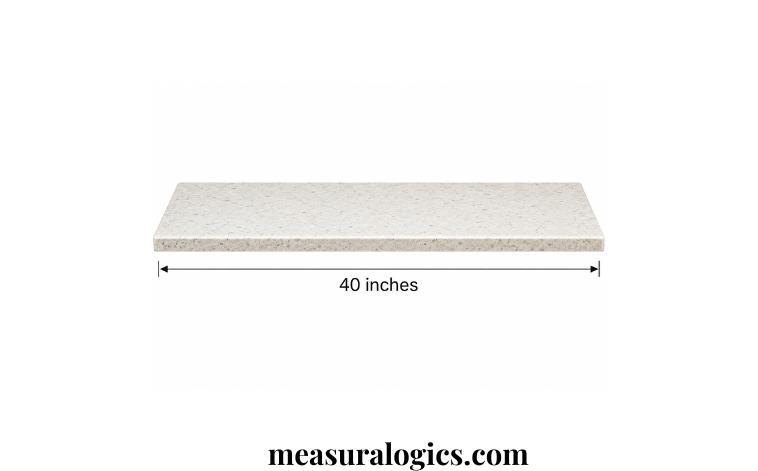
A raised kitchen counter or serving counter may stand around 40 inches tall. This provides a practical way to picture a vertical measurement in a familiar setting.
Standard kitchen worktops are often lower than 40 inches. A raised counter may be a better comparison when visualizing this height. Measure from the floor to the countertop for an accurate result.
7. Large Floor Lamp

Some compact floor lamps stand approximately 40 inches tall. Their overall height can provide a useful comparison when estimating a distance slightly above three feet.
Floor lamps come in many sizes. Some are much taller than 40 inches, while smaller models may be shorter. Check the full assembled height before using a lamp as a measuring reference.
8. Small Bookshelf
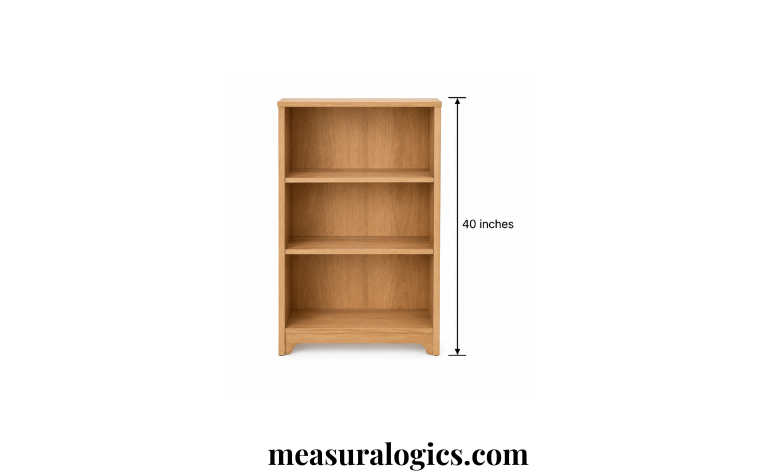
A small bookshelf may stand around 40 inches tall. This makes it a helpful household reference for understanding how high 40 inches reaches.
Imagine a bookshelf with three or four shelves standing against a wall. Its height can help you visualize the measurement without needing a ruler. Actual bookshelf heights vary, so confirm the product dimensions first.
9. Medium-Sized Suitcase

A suitcase can help illustrate combined dimensions close to 40 inches, but its height alone is usually much less. Some luggage guidelines consider the sum of a bag’s length, width, and height.
For example, a suitcase measuring 24 inches tall, 15 inches wide, and 10 inches deep has combined dimensions of 49 inches. This shows why you should not confuse total dimensions with a single 40-inch length.
10. Guitar Stand

A guitar stand provides a useful example of an adjustable object with a vertical dimension. Some stands can reach heights near 40 inches, depending on their design and adjustment settings.
The stand’s overall height is not necessarily the same as the height of a guitar resting on it. Check the stand’s specifications if you need a reliable comparison.
11. Garden Spade
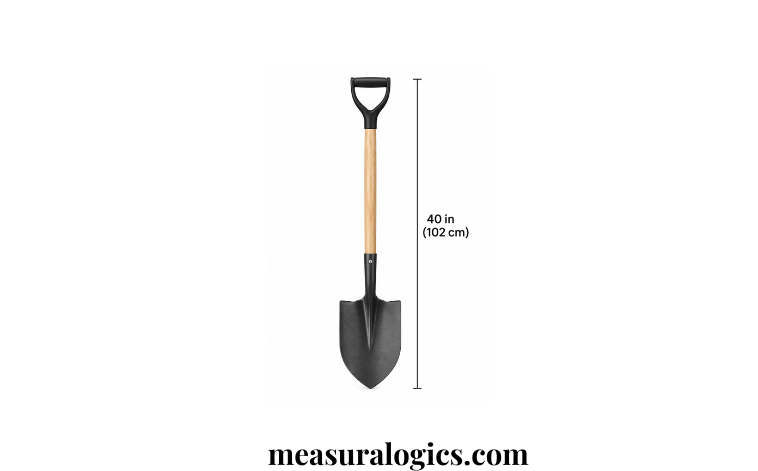
A long-handled garden spade may measure around 40 inches from the blade tip to the handle’s end. This makes it a practical example of a long tool found in many garden sheds.
Garden spades come in different lengths for digging, edging, and other tasks. Measure the complete tool rather than the handle alone to determine whether it is close to 40 inches.
12. Broom
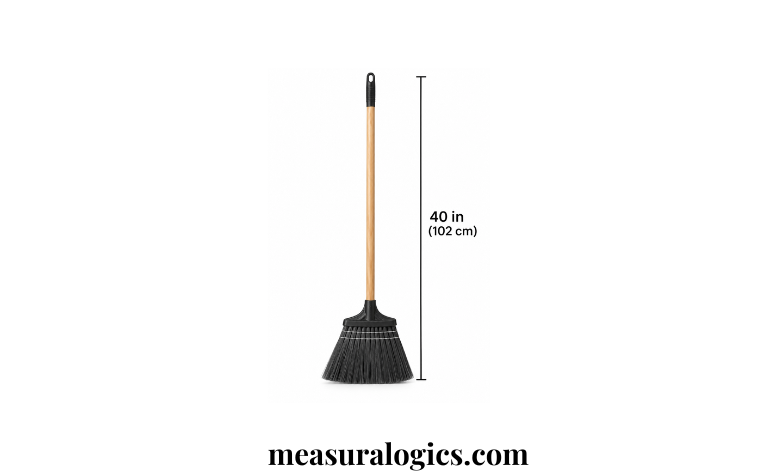
A household broom can help you visualize a long, narrow object. Some brooms measure close to 40 inches overall, although many models are longer.
Include the handle and broom head when comparing the complete item. A broom is especially useful for estimating length because its straight handle provides a clear visual reference.
13. Child’s Easel

Some children’s art easels stand around 40 inches tall. Their height makes them a helpful example for visualizing a measurement in a playroom, classroom, or art corner.
Easels vary considerably by age group and design. A tabletop easel is much shorter than a standing model, so choose a product with verified dimensions when making a precise comparison.
14. Wall Mirror

A rectangular wall mirror measuring 40 inches in height provides a straightforward way to understand this measurement. It can be mounted vertically or horizontally, depending on its design and intended use.
For example, a mirror measuring 40 inches tall and 20 inches wide has a height of 40 inches but a width of only 20 inches. Always check both dimensions when comparing mirrors or other rectangular objects.
How to Measure 40 Inches Without a Measuring Tape
You can estimate 40 inches using familiar measuring tools or a combination of smaller measurements. These methods work best when you need an approximate result.
- Use a standard ruler:
A 12-inch ruler measures one foot. Three full ruler lengths equal 36 inches. Add another four inches to reach 40. - Use a tape measure:
Extend the tape to the 40-inch mark and align its starting point with the object’s edge. - Measure in centimeters:
Since 40 inches equals 101.6 centimeters, a metric measuring tape can help you find the same distance. - Check product dimensions:
Furniture and household products often list their length, height, and width online or on their packaging. - Measure in sections:
If an object is too long for your ruler, mark successive sections carefully and add their measurements together.
For accurate work, avoid estimating with your handspan or an object of unknown size. Small errors can add up when measuring furniture, cutting materials, or planning a space.
Frequently Asked Questions
What Is 40 Inches Tall in Feet?
40 inches is 3 feet and 4 inches, or approximately 3.33 feet. Divide 40 by 12 to convert inches into decimal feet.
What Is 40 Inches in Centimeters?
40 inches equals 101.6 centimeters. To convert inches to centimeters, multiply the number of inches by 2.54.
Is 4 Feet 40 Inches?
No. Four feet equals 48 inches because each foot contains 12 inches. Therefore, 40 inches is 8 inches shorter than 4 feet.
What Does 40 Inches Look Like?
40 inches is slightly longer than three feet. You can visualize it using a long-handled garden tool, a compact bookshelf’s height, or a raised counter, provided the object’s actual dimensions are close to 40 inches.
How Big Is a 40-Inch Object?
A 40-inch object measures 101.6 centimeters in whichever direction is being measured. Its overall size depends on whether 40 inches refers to its length, width, height, or diagonal.
How Many Millimeters Are in 40 Inches?
40 inches equals 1,016 millimeters. Multiply 40 by 25.4 to convert inches into millimeters.
Final Thoughts
Understanding 40 inches becomes easier when you compare it with familiar objects and measurements. It equals 3 feet 4 inches, 101.6 centimeters, and 1.016 meters.
Furniture, garden tools, mirrors, and other household items can provide useful visual references. Remember that their dimensions vary, and an item’s length is not necessarily the same as its height or width.
When precision matters, use a ruler or measuring tape rather than relying on visual estimates. This simple approach helps you make better comparisons and measure objects more confidently.

I am Dr. Muhammad Zubair, a mathematician, researcher, and educator with a Ph.D. in Mathematics and postdoctoral research. My research work has been published in reputable, peer-reviewed international journals a reflection of my continued commitment to academic excellence and the advancement of mathematical knowledge. And I am a also experienced blogger at Measura Logic, focusing on all aspects of measurements.