

Have you ever wondered how long is 1 inch and what it actually looks like in real life? You might see measurements in a recipe, DIY project, clothing guide, or home improvement tutorial and struggle to picture such a small length. The good news is that you do not always need a ruler to understand an inch. Everyday objects can help you visualize this measurement, compare sizes, and estimate short lengths more easily.
In this guide, you will discover how big 1 inch is, how it compares to centimeters and millimeters, and 17 everyday objects that can help you picture its length.
How Long Is 1 Inch?
One inch is a unit of length commonly used in the United States and several other countries for measuring everyday objects, furniture, screens, clothing, and building materials. It is a relatively small measurement, but it can make a noticeable difference when accuracy matters.
One inch equals 2.54 centimeters or 25.4 millimeters. This is the exact conversion, so you can use it whenever you need to convert inches into metric measurements.
To visualize one inch, imagine a short section of a ruler between the zero mark and the one-inch mark. That distance represents one inch. You can also compare it with the width of a small button, a short screw, or another familiar object of a similar size.
Remember that everyday objects are not manufactured to exactly one inch unless their specifications say so. These comparisons are helpful for estimating, but a ruler or measuring tape is best when you need an accurate measurement.
How Big Is 1 Inch Compared to Centimeters and Millimeters?
Understanding the relationship between inches, centimeters, and millimeters makes it easier to picture this measurement.
Here is a quick conversion table:
| Measurement | Equivalent Length |
|---|---|
| 1 inch | 2.54 centimeters |
| 1 inch | 25.4 millimeters |
| Half an inch | 1.27 centimeters |
| Quarter of an inch | 0.635 centimeters |
| 2 inches | 5.08 centimeters |
| 3 inches | 7.62 centimeters |
A centimeter is smaller than an inch. In fact, one inch is a little more than two and a half centimeters long. A millimeter is even smaller, and it takes 25.4 millimeters to make one inch.
These conversions are particularly useful when shopping online, measuring small household items, following craft instructions, or working on home improvement projects.
17 Everyday Objects That Are About 1 Inch Long
The following objects can help you visualize how long is 1 inch in real life. Their actual sizes depend on the product, manufacturer, and design, so treat them as approximate comparisons rather than exact measuring tools.
1. Small Paper Clip

A small paper clip is a familiar office supply that can help you picture a short length. Some compact paper clips measure around one inch from end to end, although standard paper clips are often longer.
Paper clips are useful for comparing small distances because they are easy to find at home, school, or work. Place one beside a ruler to see how its length compares with the one-inch mark.
Tip: Measure your paper clip first if you want to use it as a reference for other objects.
2. Shirt Button
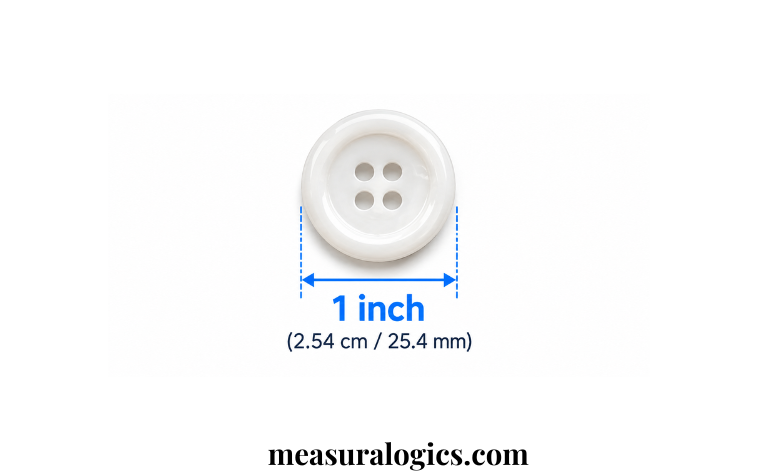
A small shirt button can be close to one inch across, depending on the garment and button style. Buttons come in many sizes, from tiny shirt buttons to larger coat and decorative buttons.
A button is a good example of how small everyday objects can help you understand measurements. Place it on a flat surface and compare its diameter with one inch on a ruler. Remember that a round button’s diameter measures across its center, not around its edge.
Tip: Choose a button with a diameter close to 2.54 centimeters for a better comparison.
3. Small Sewing Needle

Some short sewing needles are approximately one inch long, although many common sewing needles are longer. Their length varies according to the type of needle and the purpose for which it is designed.
A needle provides a useful example of a narrow object that can have a particular length without taking up much space. Because needles have sharp points, handle them carefully and keep them away from young children.
Tip: Place the needle beside a ruler on a stable surface instead of estimating its length by holding it in your fingers.
4. Mini USB Connector

A small USB connector can help illustrate a length close to one inch, depending on the connector type. However, USB plugs and their metal ends vary considerably in length, so not every connector will match this measurement.
This comparison is particularly helpful when looking at computer accessories, charging cables, and small electronic components. A connector may look tiny, yet even a fraction of an inch can matter when checking whether it fits into a particular space.
Tip: Measure the actual connector rather than assuming all USB connectors have the same dimensions.
5. Matchstick Piece
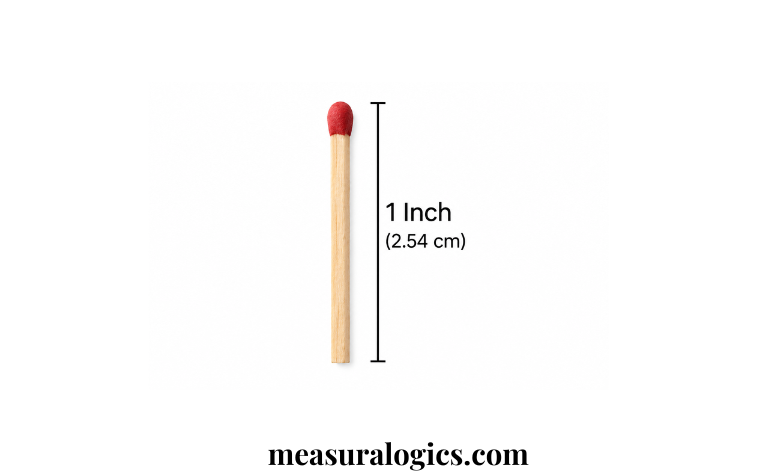
A short piece of a wooden matchstick can be cut to one inch and used as a simple visual reference. An entire matchstick is generally longer, so it should not automatically be considered a one-inch object.
This example shows how a familiar item can become a useful measuring reference when its length is known. A short wooden piece can also help with small craft projects that require approximate spacing or length.
Tip: If you use a matchstick for comparison, measure the piece first and keep matches away from flames.
6. Small Plastic Bead

Some larger craft beads measure approximately one inch across, although many decorative beads are much smaller. Bead size depends on the design, material, and intended use.
A bead is a helpful example because it makes it easy to visualize a compact measurement in three dimensions. Its width or diameter can be compared with one inch, but this is different from measuring a long, narrow object from end to end.
Tip: Check the bead’s diameter with a ruler before using it as a measurement reference.
7. Small Safety Pin

A small safety pin may measure close to one inch when measured from one end to the other. However, safety pins come in different sizes, and many are considerably longer.
This everyday sewing accessory provides a useful comparison for people who work with clothing, fabric, or craft materials. Its curved shape also reminds us that an object’s overall length may differ from the straight-line distance between its ends.
Tip: Measure the safety pin while it is closed, and handle its sharp point carefully.
8. One-Inch Screw

A screw specifically sold as a one-inch screw is one of the most reliable examples on this list. Its nominal length is generally one inch, although the measurement convention can depend on the screw’s head style and product specifications.
Screws are commonly used in furniture assembly, woodworking, and home repairs. Knowing their length helps you choose suitable fasteners for different materials and avoid using a screw that is too long or too short.
Tip: Check the manufacturer’s dimensions because screw length is measured differently for some head styles.
9. Small LEGO Piece

A small LEGO element can help you picture a measurement close to one inch, depending on its design. Many LEGO pieces are shorter than an inch, while some pieces have a length or width that approaches or exceeds it.
This comparison is useful because building blocks are familiar, easy to handle, and available in many shapes. Measuring a block can also help children understand the difference between length, width, and height.
Tip: Use a ruler to measure each side separately instead of assuming every LEGO piece has the same dimensions.
10. Pencil Eraser Piece
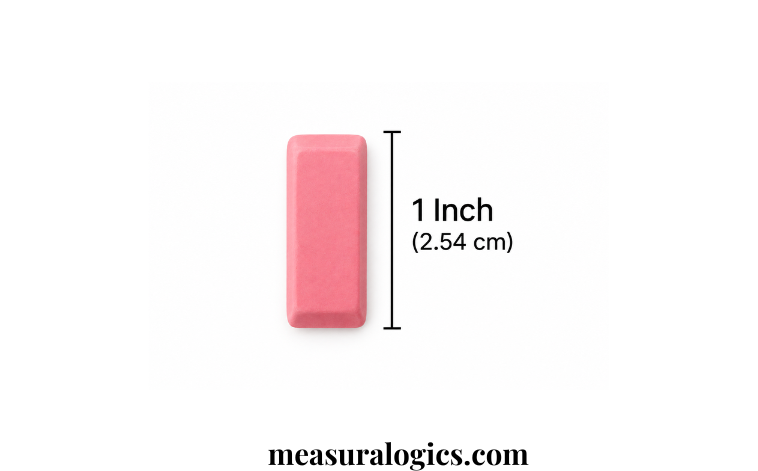
A small piece of pencil eraser can be close to one inch long, depending on the pencil and the amount of eraser remaining. Some erasers are much shorter, while larger replacement erasers can be longer.
An eraser is a convenient example because it is commonly found in pencil cases, desks, classrooms, and home offices. Its compact size makes it useful for demonstrating measurements during school activities or simple DIY tasks.
Tip: Compare the eraser’s longest straight side with the one-inch mark on a ruler.
11. Small Wooden Stick
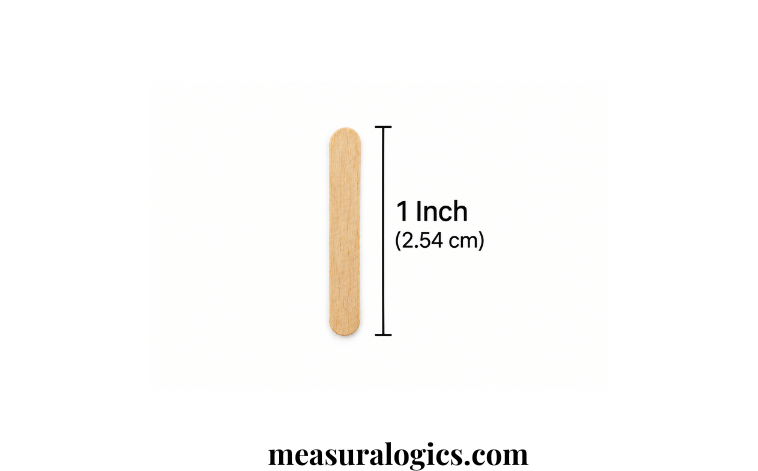
A short wooden craft stick or a cut piece of a wooden dowel can be exactly one inch long if measured and prepared accordingly. Full-size craft sticks are usually much longer, so only a suitably sized piece should be used for this comparison.
Wooden pieces are helpful when working on models, handmade decorations, miniature furniture, and school projects. They also provide a practical way to mark a known length before cutting or assembling materials.
Tip: Mark one inch with a ruler before cutting wood, and use appropriate tools safely.
12. Small Crayon Piece
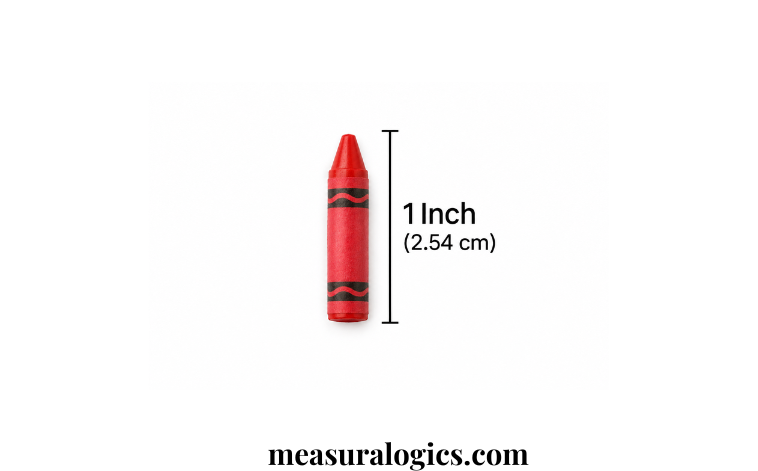
A short crayon piece can measure approximately one inch, particularly when a larger crayon has broken. Full-size crayons are generally much longer, so the length of an individual piece needs to be checked.
Crayons can help children learn about measurements through drawing, coloring, and hands-on classroom activities. Their different colors also make it easy to create visual examples of short and long distances.
Tip: Lay the crayon piece flat beside a ruler to check its length accurately.
13. Small Plastic Connector
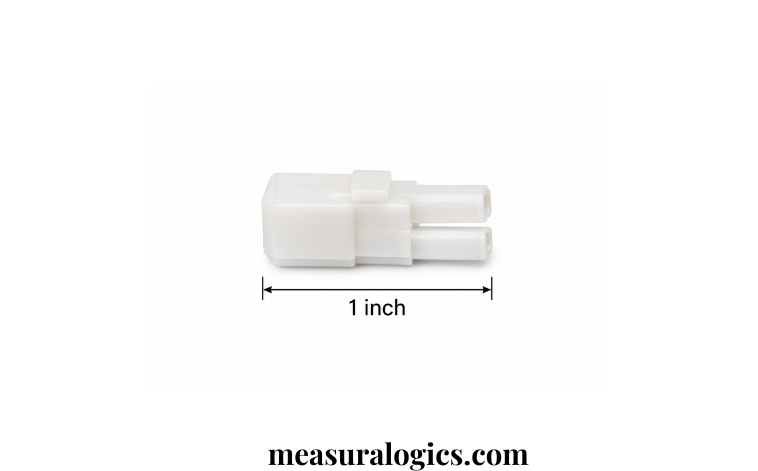
Some small plastic connectors have dimensions close to one inch, especially when designed for compact cables, tubing, or craft applications. However, their measurements depend on their specific purpose and construction.
Plastic connectors are useful examples when learning about dimensions because they often have several measurable parts. Their total length may be different from the width or diameter of the opening, so it is important to identify which measurement you need.
Tip: Measure the connector along its longest straight dimension when comparing its overall length with one inch.
14. Small Seashell

A small seashell may measure around one inch from one end to the other. Shells are natural objects, so their dimensions vary considerably according to the species and individual specimen.
A seashell makes an interesting real-life comparison because its irregular shape shows why visual estimates are not always accurate. Two shells that look similar may have different lengths, even if their overall appearance is almost identical.
Tip: Measure from the shell’s furthest end points to determine its approximate length.
15. Dry Seed
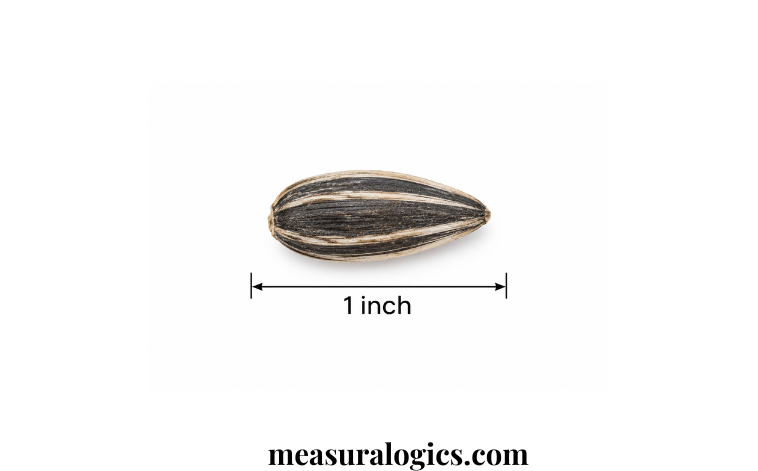
Some larger dry seeds can approach one inch in length, but many common seeds are much smaller. Their dimensions depend on the plant species, variety, and growing conditions.
Seeds can be useful for demonstrating small measurements in gardening, science lessons, and nature-related activities. However, it is better to choose a specific seed and measure it than to assume all seeds are similar in size.
Tip: Use a ruler with millimeter markings when measuring small seeds for a more precise result.
16. Small Rubber Band

A rubber band’s size can be confusing because it stretches. Its length when relaxed is different from its length when pulled straight, so it is not a dependable reference unless the measuring method is clearly defined.
A small rubber band can still demonstrate how flexible materials change shape and length. This is particularly helpful when learning why measurements should be taken under consistent conditions.
Tip: Never stretch a rubber band excessively just to make it reach one inch; measure it gently in its relaxed state.
17. Small Decorative Nail
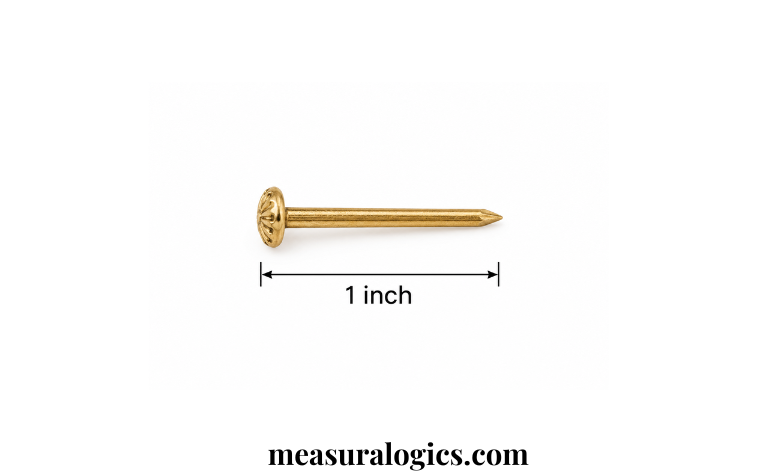
A small decorative nail may measure approximately one inch long, depending on its intended use. Some nails are designed for upholstery, crafts, or decorative furniture details, while others are significantly longer.
This is a useful example for people interested in woodworking and home improvement. Choosing the correct nail length helps with small repair projects and reduces the chance of using a fastener that is unsuitable for the material.
Tip: Check the nail’s total length and the manufacturer’s specifications before using it in a project.
Also Read: How Big Is 5mm? 15 Everyday Objects That Are About 5mm
How to Measure 1 Inch Without a Ruler
If you do not have a ruler nearby, you can still estimate one inch using familiar objects or a simple reference. However, these methods provide approximations rather than guaranteed measurements.
Use a familiar object: Find a small object whose dimensions you have already measured, such as a one-inch screw. Compare the object with the length you want to estimate.
Use your thumb as a rough guide: The width of an adult thumb near the nail may be close to one inch for some people, but thumb sizes vary. It is not a universal standard.
Use your phone carefully: You can compare an object with a known physical dimension of your phone, provided you have verified that dimension using reliable specifications or a ruler.
Make a paper reference: If you have access to a ruler once, mark a line exactly one inch long on a piece of paper. Keep the paper for future rough comparisons, taking care not to stretch or fold it.
For important tasks, such as drilling holes, cutting materials, or assembling furniture, always use a proper measuring tool.
What Does 1 Inch Look Like on a Ruler?
On a standard ruler marked in inches, the one-inch point is the first major inch mark after zero. The distance between the zero mark and that one-inch mark represents exactly one inch.
Many rulers also show smaller divisions between inch marks. Depending on the ruler, these may represent halves, quarters, eighths, or sixteenths of an inch. These markings make it easier to measure objects that are shorter than one inch or fall between whole-inch measurements.
When using a ruler, align one end of the object with the zero mark. Then look at the mark that lines up with its other end. Starting at the ruler’s physical edge instead of the zero mark can introduce an error.
Why Is Knowing the Length of One Inch Useful?
Understanding one inch can help with everyday activities, including shopping, crafts, sewing, cooking, and home improvement. For example, you might need to check a small furniture gap, understand a product’s dimensions, or follow instructions that use imperial measurements.
It is also useful when comparing product sizes online. A measurement written in inches may be difficult to imagine until you convert it to centimeters or compare it with a familiar object.
For accurate results, remember that visual comparisons are only estimates. A ruler or measuring tape will give you a more dependable answer, particularly when even a small difference can affect the final result.
Frequently Asked Questions
How long is 1 inch in centimeters?
One inch is exactly 2.54 centimeters. This conversion is useful when comparing measurements written in inches with metric measurements.
How many millimeters are in one inch?
One inch equals 25.4 millimeters. Because millimeters are smaller than centimeters, they are useful for measuring small objects and precise dimensions.
Is one inch bigger than one centimeter?
Yes. One inch is equal to 2.54 centimeters, so it is more than twice as long as one centimeter.
Can I measure one inch without a ruler?
You can estimate one inch using a familiar object, your thumb, or a previously measured paper reference. However, these methods are not guaranteed to be accurate. Use a ruler when precision matters.
What common objects are about one inch long?
Depending on their dimensions, small paper clips, buttons, sewing needles, safety pins, screws, craft pieces, and small decorative nails may be close to one inch. Always check the specific item’s size before using it as a reference.
How can I visualize one inch in real life?
Imagine the distance from zero to the one-inch mark on a ruler. You can also picture a length of 2.54 centimeters or compare it with an object that you have measured beforehand.
Is the width of a thumb about one inch?
The width of some adult thumbs is close to one inch, but this varies from person to person. Your thumb can provide a rough estimate, not an exact measurement.
Conclusion
So, how long is 1 inch? It is exactly 2.54 centimeters or 25.4 millimeters. Although this is a small distance, understanding it can make everyday measurements much easier.
From a small paper clip and shirt button to a screw, LEGO piece, or seashell, familiar objects can help you picture what one inch looks like. Just remember that their actual sizes vary, so they should be treated as visual comparisons rather than exact measuring standards.
If you need a quick estimate, these examples are a helpful starting point. If you need an accurate measurement for a project, repair, or purchase, use a ruler or measuring tape to confirm the length.

I am Dr. Muhammad Zubair, a mathematician, researcher, and educator with a Ph.D. in Mathematics and postdoctoral research. My research work has been published in reputable, peer-reviewed international journals a reflection of my continued commitment to academic excellence and the advancement of mathematical knowledge. And I am a also experienced blogger at Measura Logic, focusing on all aspects of measurements.