

Have you ever wondered how long is 50 feet in real life? Numbers can be hard to picture without a familiar object nearby. Fifty feet is a useful length for understanding spaces, vehicles, sports areas, outdoor equipment, and large structures.
If you know that one foot equals 12 inches, you can easily convert 50 feet into smaller units. Fifty feet equals 600 inches. It also equals about 15.24 meters. These conversions make the measurement easier to understand.
You may also wonder how far is 50 feet when walking. For many people, 50 feet takes only a few seconds to walk. It can feel about the length of several cars parked end to end.
This guide gives you practical examples of things that are 50 feet long. Some examples reach 50 feet exactly, while others can come close depending on their design or size.
You will see examples from sports, transportation, entertainment, construction, and outdoor activities. These comparisons can help you understand how long is 50 ft without using a measuring tape.
By the end, you should have a much clearer idea of how long 50 feet is visually. You can also use the conversion table to compare 50 feet with inches, yards, meters, and other common units.
What Is 50 Feet?
Fifty feet is a length equal to 50 individual feet placed end to end. A foot contains 12 inches, so 50 feet contains 600 inches. This makes the measurement easier to understand when comparing it with smaller objects.
In yards, 50 feet equals 16.67 yards. In meters, 50 feet equals approximately 15.24 meters. These conversions help when working with different measurement systems.
For a simple visual comparison, imagine walking across a medium-sized outdoor area. Fifty feet is long enough to span a noticeable distance. It is much longer than most rooms inside a home.
Another useful comparison is the length of several passenger vehicles. A typical car may measure around 14 to 16 feet long. Three cars placed end to end can therefore approach 50 feet.
The exact visual impression depends on the object’s width and shape. A narrow 50-foot object may look longer than a wide one. A curved object can also make the distance harder to judge.
When someone asks how long is 50ft, the simplest answer is 600 inches or 15.24 meters. However, real-life comparisons often make the measurement easier to imagine.
Fifty feet is also a useful distance for sports and outdoor activities. It can represent a practice area, a long piece of equipment, or part of a large structure.
Remember that an object’s advertised length may vary. The examples below show useful comparisons rather than claiming that every version always measures exactly 50 feet.
50 Feet Formula and Conversion
Converting 50 feet into other units is simple. The most common conversion is from feet to inches.
Since one foot equals 12 inches:
50 feet × 12 = 600 inches
Therefore, 50 feet is 600 inches long.
To convert feet into yards, divide the number of feet by three:
50 ÷ 3 = 16.67 yards
So, 50 feet equals about 16.67 yards.
For meters, multiply feet by 0.3048:
50 × 0.3048 = 15.24 meters
Therefore, 50 feet equals exactly 15.24 meters.
| Measurement | Equivalent Length |
|---|---|
| Feet | 50 ft |
| Inches | 600 in |
| Yards | 16.67 yd |
| Meters | 15.24 m |
| Centimeters | 1,524 cm |
| Millimeters | 15,240 mm |
These conversions answer common questions such as how long is 50 feet in inches and how long is 50 feet in meters.
You can also use these values for practical measurements. For example, someone working with a 50-foot garden hose can understand its size as 600 inches.
If you want to estimate the distance visually, 50 feet is about 15 large adult steps, depending on stride length. A normal walking pace may cover the distance in several seconds.
The key point is simple: 50 feet represents a substantial everyday distance. It is not extremely large, but it is much longer than typical household objects.
Comparison Table: How Long Is 50 Feet?
A comparison table makes 50 feet easier to picture. Different familiar objects can provide useful visual references.
| Example | Approximate Length or Distance |
|---|---|
| 50-foot measurement | 50 feet |
| 50-foot garden hose | 50 feet |
| Large outdoor screen structure | Around 50 feet |
| Small event tent | Can approach 50 feet |
| Bowling lane | Much shorter than 50 feet |
| Tennis court | About 78 feet long |
| Soccer goal-to-goal area | Usually much longer |
| 50-foot cable | 50 feet |
| Three average cars | Roughly 42–48 feet |
| 600 inches | Exactly 50 feet |
| 15.24 meters | Exactly 50 feet |
This table also highlights an important point. Some popular comparisons are close to 50 feet, while others are significantly longer or shorter.
For example, a tennis court is 78 feet long. That means 50 feet covers about 64% of its length. A standard bowling lane is only 60 feet from the foul line to the headpin, so 50 feet covers most of that distance.
When comparing objects, always check whether the measurement refers to the whole object. A fire truck with an extended ladder may reach around 50 feet or more, but its exact length depends on the model.
These comparisons are helpful because they turn an abstract number into something familiar. They can also help children understand measurements without needing complicated math.
School Bus
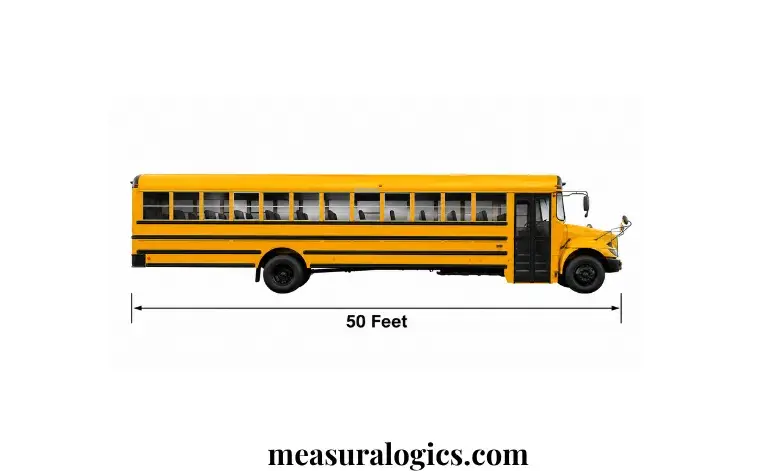
A school bus is a useful vehicle for understanding how long is 50 ft. Large school buses can measure around 40 feet long, although dimensions vary by model.
A 50-foot distance would therefore be somewhat longer than a typical full-size school bus. Imagine placing a school bus on a straight line. Then add another 10 feet beyond its rear.
That extra distance gives you a practical visual idea of 50 feet. It is not an exact comparison for every school bus, but it is easy to picture.
Some smaller school buses measure much less than 40 feet. Large models can approach or exceed 40 feet. Because of these differences, you should not assume every school bus measures exactly 50 feet.
A 50-foot distance can also help when thinking about school bus parking areas. A vehicle this long needs enough room for safe movement, turning, and loading.
If you stand 50 feet away from a school bus, it will appear noticeably smaller than when standing close to it. This shows why distance and length are different concepts.
For visual learning, imagine one large school bus followed by roughly another 10 feet. That gives a reasonable mental picture of 50 feet.
The comparison is especially useful for students. Most people have seen a school bus, making it easier to understand than a bare number.
Remember that the bus itself may not be exactly 50 feet. Use it as a visual reference rather than a precise measuring tool.
Also read: 12 Common Things That Are About 300 Feet Long or Tall
Bowling Lane
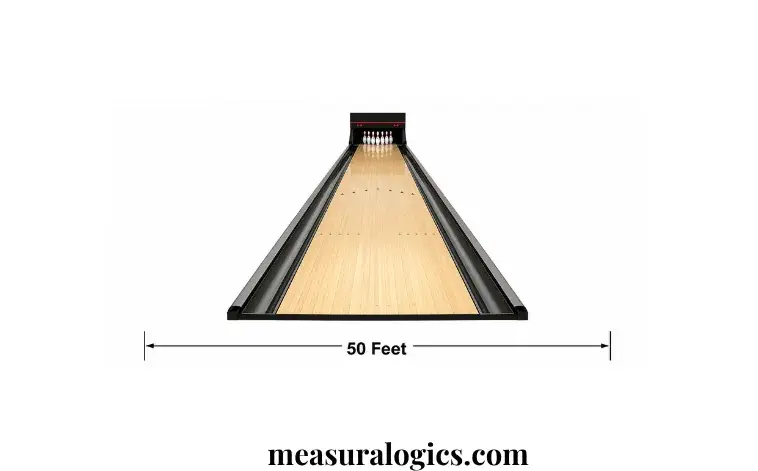
A bowling lane provides an interesting comparison for 50 feet. A standard bowling lane measures 60 feet from the foul line to the headpin.
That means 50 feet covers most of the usable lane length. It leaves about 10 feet between the 50-foot mark and the headpin.
This makes a bowling lane one of the best familiar examples for understanding how far 50 feet can reach.
Imagine standing at the foul line and looking toward the pins. The pins sit at the end of a 60-foot lane. A point 50 feet away would be close to the pin area.
The lane itself has a narrow shape. This can make the distance feel longer than it would across a wide open area.
Bowling lanes also demonstrate why exact measurements matter. The playing surface has carefully defined dimensions, so it provides a better reference than objects with changing sizes.
If someone asks how far is 50ft, you could explain it as about five-sixths of a standard bowling lane.
Fifty feet is therefore not a short distance. It can stretch almost the entire length of a bowling lane.
The comparison is especially useful because bowling lanes are familiar to many people. You do not need to imagine an unusual object.
However, remember that the 60-foot lane measurement is a specific bowling standard. A 50-foot distance is being used only as a comparison.
Fire Truck With Ladder Extended

A fire truck with its ladder extended can provide another useful visual comparison. Some aerial ladder trucks can raise ladders to heights around or above 50 feet.
The important distinction is between the truck’s physical length and its ladder height. A fire truck itself is usually much shorter than 50 feet.
When the ladder rises, however, its reach can become several times longer than the truck’s body.
Imagine a ladder extending upward from a fire truck. A 50-foot reach would rise roughly as high as a five-story building, depending on floor height.
This makes a 50-foot ladder an impressive visual example. It shows that 50 feet can represent both horizontal distance and vertical height.
Fire departments use different truck sizes and ladder designs. Therefore, not every fire truck reaches exactly 50 feet.
Some ladders extend far beyond 50 feet. Others have shorter maximum reaches. The exact specifications depend on the vehicle.
For understanding measurement, imagine laying the extended ladder flat on the ground. A 50-foot ladder would stretch 600 inches from one end to the other.
This comparison helps answer how long is 50 feet visually. It gives you a large object that can occupy a significant amount of space.
Always remember that ladder reach is not the same as truck length. The example demonstrates scale rather than claiming every fire truck measures 50 feet.
Shipping Container Row
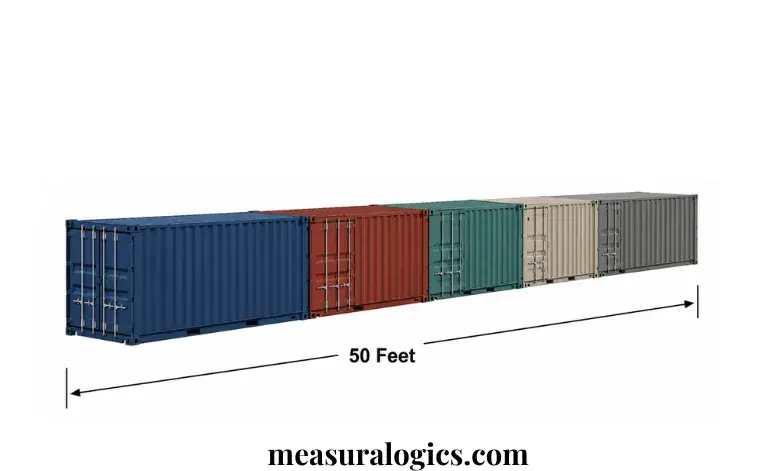
A row of shipping containers can create a strong visual comparison for 50 feet. Standard shipping containers commonly measure 20 or 40 feet long.
Two 20-foot containers placed end to end create exactly 40 feet. Adding another 10 feet brings the total to 50 feet.
This makes containers useful for understanding the distance in industrial areas.
Imagine a 40-foot container followed by another 10 feet of open space. That total distance equals 50 feet.
Alternatively, picture two 20-foot containers placed together. Their combined length would be 40 feet, leaving another quarter of that length to reach 50 feet.
Shipping containers are rigid and rectangular. Their straight edges make them easier to compare with a measured distance.
However, container dimensions can vary slightly depending on the design. Some containers have different lengths, heights, and construction features.
The example is mainly useful because 20-foot and 40-foot container sizes are common references in shipping.
If you are standing beside a container yard, 50 feet can seem easier to judge. A row of containers gives you a clear horizontal reference.
This also shows how everyday objects can help estimate measurements. You do not always need a tape measure to get a rough idea.
For an exact measurement, always use a measuring device. Visual comparisons are useful for understanding scale, not for precise construction work.
Giant Inflatable Slide
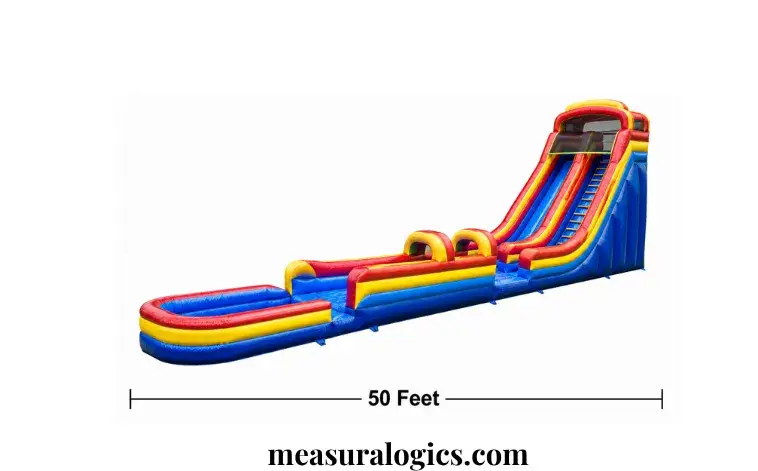
A giant inflatable slide can sometimes provide a useful example of a structure approaching 50 feet. Large event slides come in many different sizes.
Some inflatable slides are designed for children. Others are built for festivals, fairs, and large outdoor events.
The biggest versions can reach several stories in height or stretch significant distances along the ground.
A 50-foot inflatable structure would be much larger than a typical backyard slide. It could dominate an outdoor event area.
Imagine a straight inflatable slide measuring 50 feet from one end to the other. That equals 600 inches.
The size becomes easier to picture when compared with cars. A 50-foot slide could be longer than three average passenger cars placed end to end.
Its height may not equal its length. Many inflatable slides have steep slopes, so their overall measurements can include height, width, and length.
Because manufacturers create different designs, you should check the product specifications before treating a slide as exactly 50 feet.
Still, giant inflatables provide a strong visual reference. Most people understand that a commercial inflatable attraction is much larger than ordinary playground equipment.
This example also demonstrates why measurements should include units. Saying a slide is “50” means little without knowing whether the number represents feet, inches, or meters.
When someone asks how far is 50 feet, imagine walking from one end of a giant inflatable attraction to the other.
That mental image can make the distance easier to understand.
Tennis Court

A tennis court is longer than 50 feet, making it a useful comparison. A standard tennis court measures 78 feet from one baseline to the other.
That means 50 feet represents about 64% of the court’s full length.
Imagine standing at one baseline and walking toward the opposite baseline. After traveling 50 feet, you would still have about 28 feet remaining.
This comparison shows that 50 feet is substantial, but it is not the full length of a tennis court.
The court’s width also changes how the distance looks. A singles court is narrower than a doubles court, even though the overall length remains the same.
Using a tennis court can help answer how long is 50 feet visually. It provides a familiar sports setting with clear boundaries.
If you want to estimate 50 feet outdoors, look at a tennis court. A point roughly two-thirds of the way across the court is close to 50 feet.
The exact percentage is approximately 64.1%. This makes the tennis court a strong real-world scale reference.
It also helps demonstrate the difference between length and area. A tennis court has a fixed length, but its total playing area depends on both length and width.
Remember that 50 feet is shorter than a regulation tennis court. So the court should be used as a comparison, not an exact 50-foot object.
Garden Hose
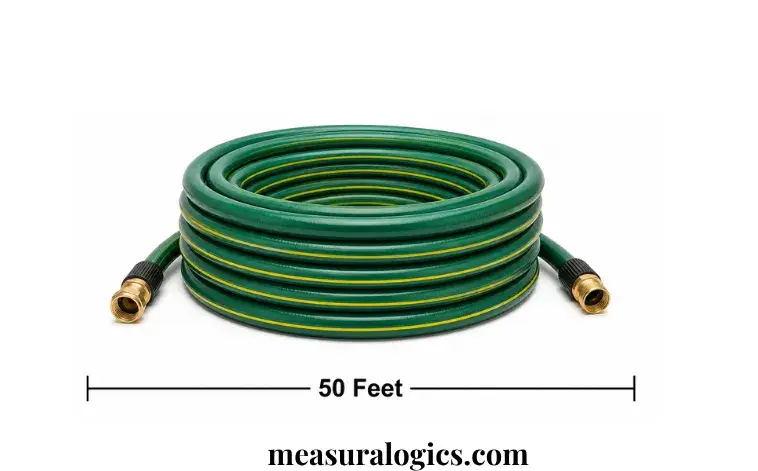
A 50-foot garden hose is one of the most direct examples of something that measures 50 feet long.
Garden hoses commonly come in several lengths. A 50-foot model is widely useful for reaching gardens, lawns, driveways, and outdoor cleaning areas.
If the hose is fully stretched straight, its end-to-end length can measure 50 feet.
That equals 600 inches or 15.24 meters.
The hose may look shorter when coiled. A tightly wound 50-foot hose takes up much less space visually.
This demonstrates an important measurement idea. The actual length of an object can stay the same even when its shape changes.
A hose also bends around trees, plants, corners, and outdoor furniture. These bends do not change the total length of the hose.
If you want to understand how long is 50 ft, imagine stretching a 50-foot hose across a lawn.
You could also place it beside a measuring tape to check the actual length. This is more accurate than estimating by sight.
Garden hoses often have their length printed on packaging or product labels. Always check the stated size because hoses come in many lengths.
A 50-foot hose is particularly useful as a visual example because it can be stretched into a straight line.
It gives you a practical way to see the difference between 25, 50, and 75 feet.
Water Slide
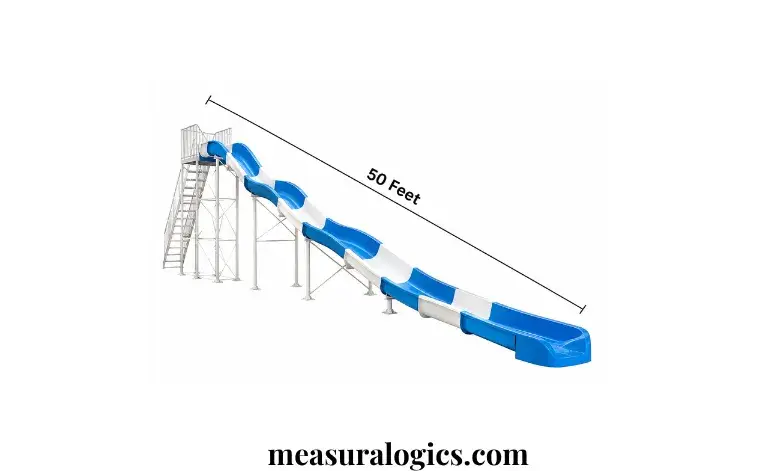
Large water slides can provide another visual reference for 50 feet. However, their measurements vary greatly by design.
A water slide can be measured by its height, sliding surface, or total structure length. These numbers are not always the same.
A slide with a 50-foot height would be a substantial attraction. It could rise several stories above the ground.
A 50-foot slide length would also provide a significant distance for riders to travel.
This makes water slides useful when explaining how long is 50 feet visually. Their large size gives people an easy mental reference.
Imagine a water slide extending 50 feet from its starting point to another point along its structure. That equals 15.24 meters.
The slide may curve or twist. Because of this, measuring the actual sliding path can produce a different result from measuring a straight line between two points.
Large water parks use slides with different dimensions. Some are much longer than 50 feet, while smaller slides can be much shorter.
Therefore, you should not assume that every large water slide measures 50 feet.
Instead, use a 50-foot slide as a scale example. It represents a structure large enough to be clearly visible from a distance.
The comparison also helps explain why measuring curved objects can be complicated. The path itself may have a greater length than the straight-line distance.
Roller Coaster Track Section
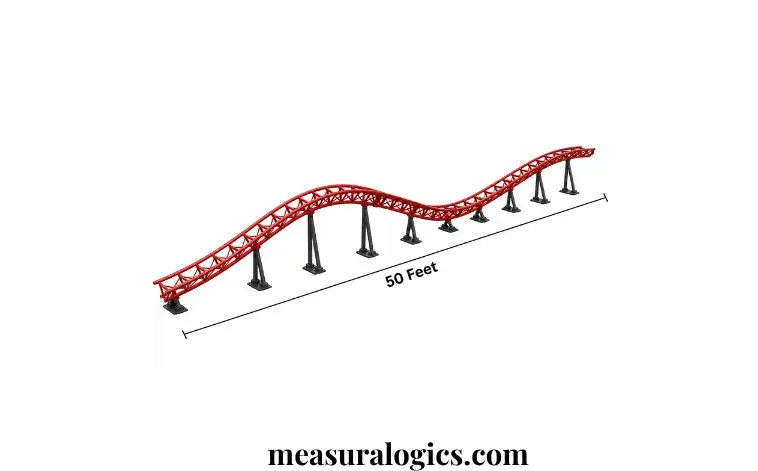
A roller coaster track provides an exciting way to visualize 50 feet. A track section can easily measure 50 feet or more.
Roller coasters contain straight sections, curves, hills, drops, and turns. Their total track length can stretch thousands of feet.
A single 50-foot section would therefore represent only a small part of a complete ride.
Imagine a straight section of track measuring 50 feet. It would stretch farther than many rooms and most residential driveways.
A curved track makes the measurement more interesting. The track’s actual path can be longer than the straight-line distance between its endpoints.
For example, two points might be 50 feet apart directly. A curved section connecting those points could require more than 50 feet of track.
This distinction matters when discussing how far is 50ft.
Roller coaster track is also useful for understanding vertical distance. A 50-foot hill is very different visually from a 50-foot straight track section.
Both measurements involve 50 feet, but their positions in space differ.
Large amusement parks often publish ride specifications. If you need an exact measurement, check the manufacturer’s or park’s information.
For general learning, imagine a 50-foot straight section of coaster track. It would be about 15.24 meters long.
That is a substantial distance, especially when the track rises or falls along its route.
Airport Jet Bridge

An airport jet bridge can provide another helpful scale comparison. Jet bridges connect airport terminals with aircraft doors.
Their lengths vary based on airport design and aircraft parking positions. Some are relatively short, while others extend significant distances.
A 50-foot jet bridge would stretch about 15.24 meters between connection points.
This is long enough to span a large room or outdoor gap.
Jet bridges often have movable sections. They extend toward an aircraft and can change position as needed.
Because the structure moves, its maximum reach and current position may differ.
If you imagine a jet bridge fully extended to 50 feet, it would provide a clear example of the distance.
Airport equipment also shows why length measurements matter. The bridge needs enough reach to connect safely with different aircraft positions.
However, not every airport jet bridge is 50 feet long. Designs vary widely between airports and aircraft gates.
The comparison should therefore be treated as a visual example rather than a universal measurement.
For travelers, the jet bridge is a familiar object. Most people have walked through one, making it easier to understand than an abstract 15.24-meter measurement.
If you imagine three average cars placed end to end, you can also get a rough sense of the length.
A 50-foot jet bridge would be slightly longer than that comparison.
Large Flagpole
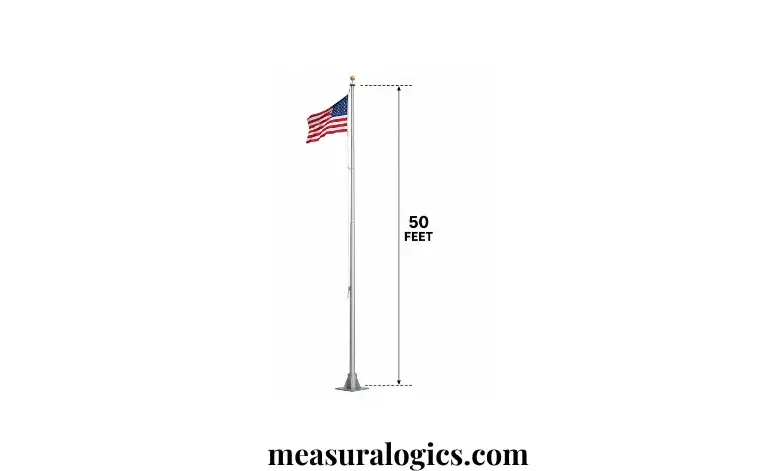
A large flagpole can help explain 50 feet as a vertical measurement. Many flagpoles range from small residential poles to very tall commercial structures.
A 50-foot flagpole would rise high above most nearby objects.
It could be several times taller than a typical one-story home. Its exact visual height would depend on nearby buildings and trees.
Imagine looking straight up at a flagpole that reaches 50 feet. The top would be far above normal eye level.
This gives a different perspective on how long is 50 feet. Length does not always have to run horizontally.
A vertical 50-foot measurement can feel much larger because you cannot easily see the entire distance at once.
Flagpoles also show why perspective affects visual estimates. A tall object viewed from close range can appear much shorter or taller than expected.
The pole itself may have a tapered design. Its width can change from the base to the top.
However, the overall height remains measurable from the ground to the highest point.
A 50-foot flagpole equals 600 inches and 15.24 meters. These conversions make it easier to compare the pole with other tall structures.
Not every large flagpole is 50 feet. Some are much taller, especially those used at government buildings, stadiums, and large public spaces.
Still, a 50-foot pole is a useful example of how high this measurement can reach.
Suspension Bridge Cable
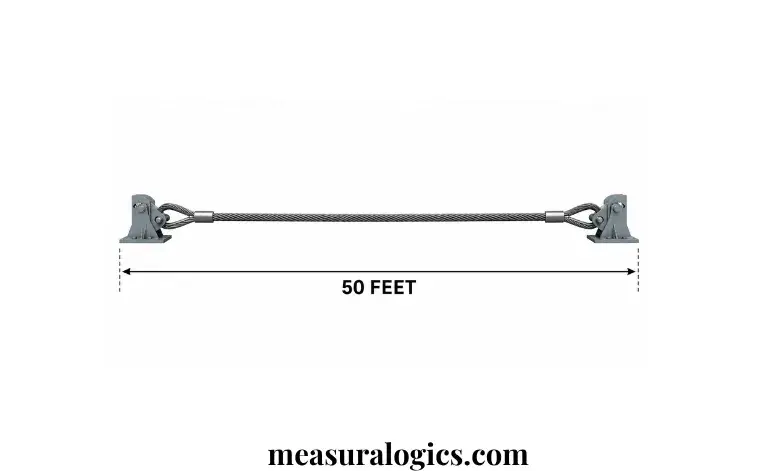
A suspension bridge cable can be much longer than 50 feet, but a 50-foot section provides a useful measurement example.
Large suspension bridges use cables that stretch over long distances. Their main cables can measure hundreds or thousands of feet.
A 50-foot section would represent only a small part of the overall cable system.
Imagine cutting out a straight 50-foot section of cable and placing it on the ground. It would stretch about 15.24 meters.
The cable’s thickness can make it look shorter than it really is. A large object can sometimes seem visually compressed.
Suspension bridges also contain curves. The main cables typically form a curved shape between support towers.
This creates an important distinction between straight-line distance and the actual length of the cable.
If two points are 50 feet apart, the cable connecting them may need to be slightly longer.
For simple measurement practice, however, a straight 50-foot cable is easy to understand.
Bridge cables also show how measurements work in large engineering projects. Engineers use precise measurements to design safe structures.
You should not use a visual estimate for real construction or engineering work.
For everyday learning, the example is still valuable. A 50-foot cable is long enough to cross a large outdoor area.
It also gives another answer to how long is 50 ft. Think of 50 feet as a cable stretching across a sizeable space.
Circus Tent
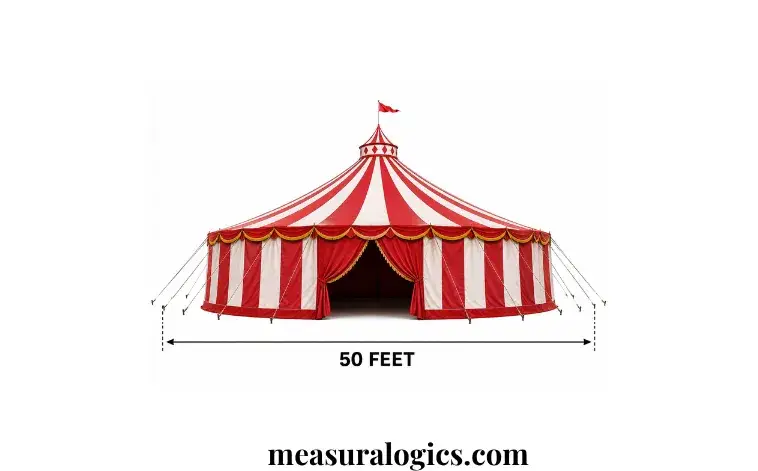
A large circus tent can approach or exceed 50 feet across. Event tents come in many sizes, so there is no single standard dimension.
A 50-foot-wide tent would create a large covered area. It could provide enough room for performances, seating, equipment, or gatherings.
Imagine standing at one side of the tent and looking toward the opposite side. A 50-foot span would cover 600 inches.
The tent’s height may be different from its width. Large tents often have high central points supported by poles or other structures.
This makes them useful for visualizing both horizontal and vertical measurements.
A 50-foot tent is also much larger than a typical backyard party tent.
The exact dimensions depend on the manufacturer, event requirements, and tent design.
Some circus and event tents are far larger than 50 feet. Others are smaller and designed for smaller gatherings.
Therefore, the tent should be considered a practical size comparison rather than an exact universal example.
If you have seen a large event tent, imagine extending its width to 50 feet. This can help you understand the scale.
The comparison is especially useful for people who struggle to picture 15.24 meters.
Instead of imagining meters, picture a large tent stretching across a wide outdoor area.
That is roughly the scale of 50 feet.
Soccer Goal-to-Goal Practice Net

A soccer field is much longer than 50 feet, but a practice net can sometimes provide a useful comparison.
A regulation soccer field can range widely in size. Goal-to-goal distances are generally far greater than 50 feet.
Therefore, 50 feet should not be confused with the full length of a soccer field.
A 50-foot practice net, training barrier, or temporary net system would provide a more direct comparison.
Imagine a straight net stretching 50 feet across a practice area. It would cover 600 inches.
This could create a noticeable training space for passing, shooting, or ball control drills.
Sports equipment varies by manufacturer, so practice nets do not all have the same dimensions.
The useful idea here is scale. A 50-foot net would be longer than many residential yards are wide.
If you place the net across an open field, you can clearly see how far 50 feet extends.
This also helps answer how far is 50 feet to walk. Walking from one end of the net to the other would cover the same distance.
For most adults, that walk would take only several seconds at a normal pace.
However, walking speed varies from person to person. Children and older adults may take longer.
Use the net as a visual reference, not as a fixed sports standard.
The exact length should always come from the equipment specifications.
Outdoor Movie Screen Structure
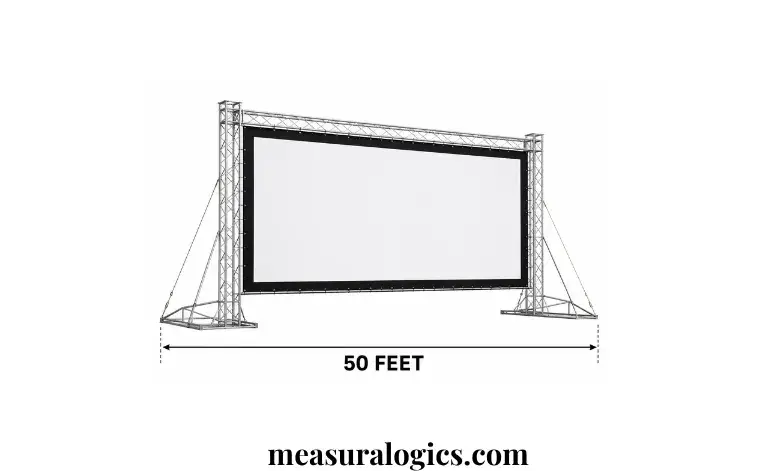
A large outdoor movie screen structure can approach 50 feet across. Event organizers use large screens for concerts, festivals, drive-in movies, and community gatherings.
The screen itself may be much smaller or larger than 50 feet. However, a 50-foot-wide structure gives a useful idea of the scale involved.
Imagine a screen stretching 50 feet from one side to the other. That equals 15.24 meters.
Such a screen would look enormous compared with a typical home television.
The structure supporting the screen may also add height. Depending on its design, the overall installation can become much taller than 50 feet.
This is another example where length and height should not be confused.
A screen measuring 50 feet wide does not necessarily stand 50 feet tall.
Large outdoor screens also provide a useful visual comparison because their straight edges make the width easy to understand.
Imagine walking from the left edge to the right edge. You would travel 50 feet.
That makes it easier to understand how long is 50 feet visually.
Outdoor movie structures vary greatly in size. Some portable screens are small enough for backyards. Others are built for large public events.
Always check the manufacturer’s specifications for exact dimensions.
For general measurement purposes, a 50-foot screen is a strong example of how large 15.24 meters can look in an open space.
Common Mistakes People Make
People often make simple mistakes when estimating 50 feet. The most common mistake is confusing feet with inches.
Fifty feet equals 600 inches. It does not equal 50 inches.
Another common mistake is confusing feet with yards. Three feet make one yard. Therefore, 50 feet equals about 16.67 yards.
People also confuse 50 feet with 50 meters. These measurements are different. Fifty meters equals about 164 feet.
A third mistake involves assuming every object listed as a comparison measures exactly 50 feet.
A school bus, water slide, fire truck ladder, or circus tent can have different dimensions. Manufacturers create many sizes.
You should treat these objects as visual references unless their specifications confirm a 50-foot measurement.
Another mistake involves confusing height with length. A 50-foot flagpole measures 50 feet vertically. A 50-foot hose measures 50 feet along its length.
Curved objects can cause another problem. The straight distance between two points may differ from the object’s actual path.
For example, a curved roller coaster section can contain more than 50 feet of track even when its endpoints are 50 feet apart.
Walking estimates can also be inaccurate. People have different stride lengths and walking speeds.
If you need an exact 50-foot measurement, use a measuring tape, survey tool, or another reliable measuring device.
Visual comparisons work best for understanding scale. They should not replace precise measurements when accuracy matters.
FAQs: How Long Is 50 Feet?
How long is 50 feet in inches?
50 feet equals 600 inches. This comes from multiplying 50 by 12 because one foot contains 12 inches.
How long is 50 feet in meters?
50 feet equals 15.24 meters. The conversion uses the standard value of 0.3048 meters per foot.
How far is 50 feet to walk?
For many people, walking 50 feet takes only several seconds. The exact time depends on walking speed, stride length, and the surface.
How long is 50 feet visually?
Fifty feet is roughly the length of three average cars placed end to end. It is also about two-thirds the length of a standard tennis court.
What are some things that are 50 feet long?
A 50-foot garden hose is a direct example. Other objects can approach 50 feet, including large event structures, cables, and some commercial equipment.
Conclusion
Understanding 50 feet becomes much easier when you compare it with familiar objects. A number alone can be difficult to picture. Real-life examples turn that number into something you can see and understand.
Fifty feet equals 600 inches, 16.67 yards, and 15.24 meters. These conversions give you several ways to understand the same distance.
You can also picture 50 feet as a little more than three average cars placed end to end. A tennis court provides another useful comparison because 50 feet covers about two-thirds of its length.
A 50-foot garden hose is an even more direct example. When fully stretched, it gives you a clear representation of the distance.
Other examples in this guide include school buses, bowling lanes, fire truck ladders, shipping containers, inflatable slides, water slides, roller coaster sections, jet bridges, flagpoles, bridge cables, circus tents, practice nets, and outdoor movie screens.
Remember that many of these objects come in different sizes. Their actual dimensions can vary by manufacturer, design, or use. Always check official specifications when you need an exact measurement.
For simple visual learning, however, these examples can make how long is 50 feet visually much easier to understand.
The next time you hear someone mention 50 feet, think about a long garden hose, several cars, or most of a bowling lane.
Use these comparisons to estimate distances in everyday situations. And if you need more helpful measurement comparisons, explore other guides to understand common lengths in inches, feet, yards, and meters.

I am Dr. Muhammad Zubair, a mathematician, researcher, and educator with a Ph.D. in Mathematics and postdoctoral research. My research work has been published in reputable, peer-reviewed international journals a reflection of my continued commitment to academic excellence and the advancement of mathematical knowledge. And I am a also experienced blogger at Measura Logic, focusing on all aspects of measurements.